Why Over-the-Counter Sprays Multiply Argentine Ant Infestations in Southern California
Discover why reaching for a can of bug spray often worsens Argentine ant problems, how budding fractures colonies into multiple satellite nests, and the professional methods that achieve true control.
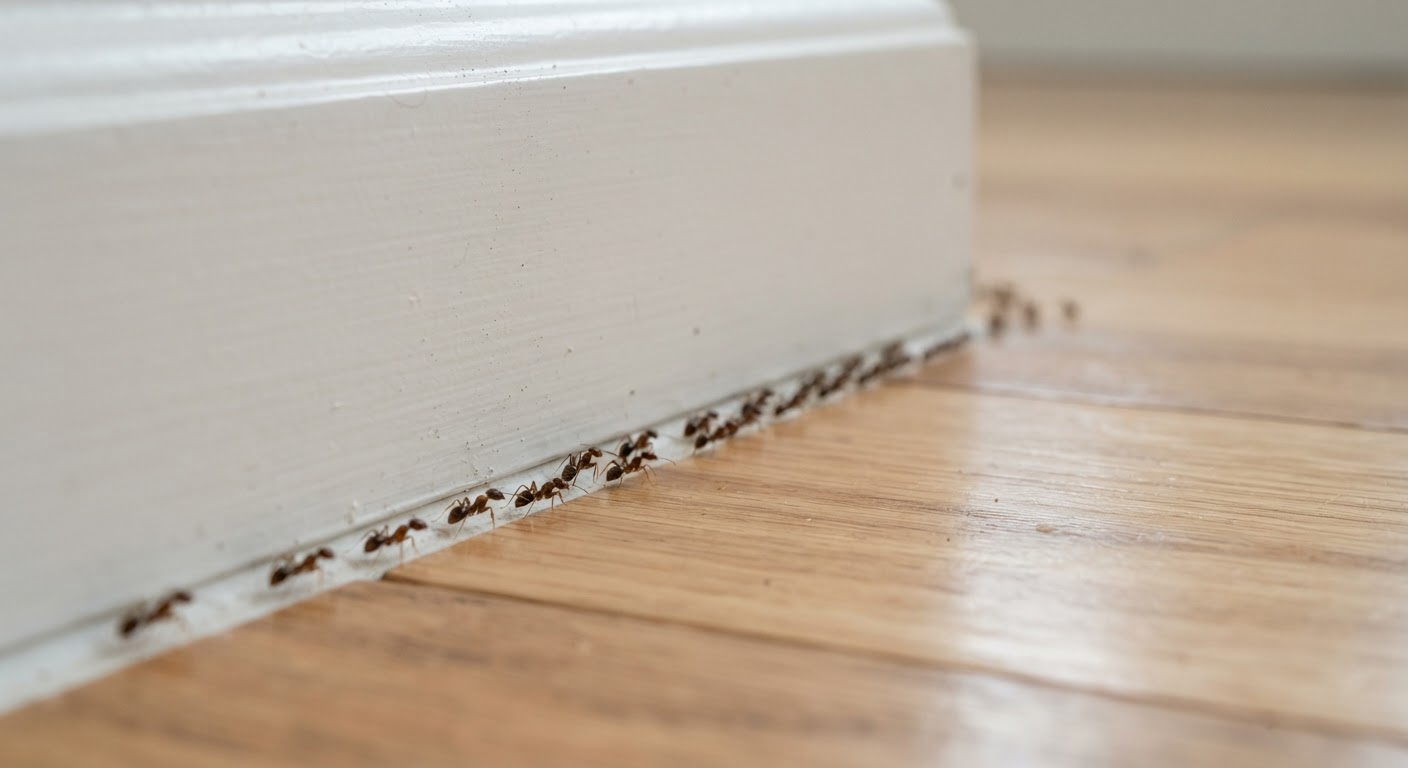
The Frustration of the Persistent Trail
For homeowners across Los Angeles, the sudden appearance of a dense, dark ribbon of tiny brown ants along a kitchen baseboard or bathroom countertop is a familiar headache. The instinctive reaction is almost universal: pull out an aerosol can of household insect spray or reach for a store-bought jug of perimeter defense, dousing the visible trail until every moving insect stops in its tracks.
For a day or two, it appears the problem is solved. The counter is clean, and the trail is gone. Within a week, however, the situation often takes a dramatic turn for the worse. Instead of one single trail leading to the sink, trails emerge in the pantry, beneath the dishwasher, near the laundry room, and along the hallway baseboards. Rather than eliminating the invasion, the spray has effectively multiplied it. Understanding why this happens requires a closer look at the unique biology of the Argentine ant and a destructive survival mechanism known as colony budding.
The Biology of a Supercolony
The Argentine ant (Linepithema humile) is not like native North American ant species. In their native range in South America, competing colonies frequently fight one another, keeping populations balanced. However, when Argentine ants were accidentally introduced to California in the late nineteenth and early twentieth centuries, genetic bottlenecks created an unusual phenomenon: unicoloniality.
Because individuals share remarkably similar genetic profiles, Argentine ants from different nests do not recognize each other as enemies. Instead of competing for resources and defending territorial boundaries, nests cooperate seamlessly, forming what entomologists classify as a supercolony. Virtually all Argentine ants throughout urban and suburban Southern California belong to this interconnected network.
In addition to cooperation across vast distances, Argentine ant colonies possess another critical characteristic: polygyny. Unlike species that rely on a single, central queen buried deep within a master nest, a single Argentine ant nest can harbor dozens, or even hundreds, of reproductive queens. This combination of cooperating nests and multiple fertile queens makes them exceptionally resilient to traditional pest control tactics.
The Budding Phenomenon: How Fast-Acting Sprays Backfire
Most consumer-grade insecticides and standard perimeter treatments rely on pyrethroids or other fast-acting, repellent chemicals. These products work on contact, disrupting the nervous system of the insect almost immediately. While watching an insect drop instantly provides immediate satisfaction, it is the worst possible approach when dealing with a polygynous species.
When a repellent spray is applied to a baseboard or patio edge, three major events occur beneath the surface:
- Foraging Disruption: Only a small fraction of any ant colony—typically less than ten percent—actively forages outside the nest at any given moment. Contact sprays kill these visible foragers, leaving ninety percent of the population completely untouched.
- Chemical Repellency: The surviving ants quickly detect the chemical barrier. Argentine ants have highly sensitive sensory organs and perceive the sudden death of their trail mates along with the caustic residue of the spray as an existential threat to the nest.
- Colony Budding: Alarmed by the perceived destruction of their foraging route and the localized chemical threat, the colony enters emergency survival mode. Queens, accompanied by clusters of workers and brood (eggs, larvae, and pupae), rapidly mobilize and scatter in multiple directions. They retreat behind walls, under subfloors, beneath concrete slab cracks, and into quiet wall voids, establishing multiple new, independent satellite nests.
By attempting to wipe out a single trail with a quick-kill spray, a homeowner inadvertently fractures one manageable exterior trail into three or four interior colonies. Each new queen continues laying eggs, and within days, each satellite nest sends out its own foraging trails in search of moisture and food.
Why Los Angeles Climates Intensify the Struggle
Environmental conditions throughout the greater Los Angeles basin play a substantial role in driving Argentine ant behavior. The region's Mediterranean climate features long, dry summers followed by mild, occasionally wet winters. Both weather extremes put pressure on ant colonies to move indoors.
During extended periods of summer heat and drought, exterior soil dries out, and natural nectar sources diminish. Seeking moisture, worker ants exploit tiny structural gaps around weep holes, plumbing penetrations, and door thresholds to access kitchens, bathrooms, and utility closets. Similarly, when rare heavy winter rains saturate the soil, outdoor nests risk flooding, prompting queens and brood to relocate into warm, dry wall voids and raised foundation subfloors.
Urban and suburban landscaping practices further compound the issue. Irrigated lawns, drip systems, ornamental mulch beds, and flowering shrubs provide the artificial oasis Argentine ants need to maintain peak populations year-round. Furthermore, Argentine ants actively "farm" common garden pests such as aphids, scale insects, and whiteflies, protecting these plant-sucking insects from predators in exchange for sweet honeydew. This reliable food supply allows colonies to expand rapidly right against residential foundations.
The Professional Approach: Slow-Acting Non-Repellents and Trophallaxis
Managing an Argentine ant infestation requires working with their natural biology rather than fighting against it. Professional pest control relies on strategies that neutralize the reproductive engine of the colony without triggering the panic response that causes budding.
Non-Repellent Chemistries
Unlike store-bought sprays, professional-grade non-repellent liquid products are completely undetectable to ants. When applied around the exterior perimeter, worker ants continue their normal movement, crossing directly over the treated surface without realizing it. Because the active ingredients are formulated to be slow-acting, the ants do not die immediately. Instead, microscopic amounts of the material adhere to their cuticles as they return to the nest.
Social Sharing Through Trophallaxis
Ants feed one another through a process known as trophallaxis—the mutual transfer of liquid food and glandular secretions between nestmates. When foraging workers ingest slow-acting liquid or gel baits, or when they carry non-repellent materials on their bodies back into the nesting galleries, they groom each other and distribute the product directly to the queens and developing larvae.
Because the mortality is delayed, the material spreads thoroughly throughout the entire social structure before the colony detects a problem. When the queens succumb to the treatment, reproduction halts, and the satellite nests collapse organically from within, preventing the budding cycle from ever taking place.
Supporting Control Through Exclusion and Habitat Modification
While targeted professional treatments handle the biological core of the infestation, physical prevention minimizes the pressure on your home. Homeowners can take several practical steps to reduce ant attraction:
- Manage Exterior Moisture: Repair leaking outdoor spigots, ensure irrigation heads point away from the foundation, and make sure soil grades allow water to drain away from the structure.
- Prune Surrounding Vegetation: Tree limbs, dense ivy, and overgrown shrubs that touch exterior walls or rooflines serve as direct structural bridges, allowing ants to bypass ground-level defenses entirely.
- Address Food Attractants: Store pantry goods, particularly sugars, cereals, and pet kibble, in airtight glass or rigid plastic containers. Wipe down surfaces to remove invisible pheromone trails left by previous scouts.
- Seal Physical Gaps: Inspect the perimeter where utilities, air conditioning conduits, and gas lines enter the structure, sealing gaps with appropriate silicone or polyurethane caulking.
Resolving the Infestation at the Source
Argentine ants are among the most persistent pests in Southern California, and their complex colony dynamics make conventional DIY measures counterproductive. When over-the-counter sprays cause trails to scatter, breaking the cycle requires a measured, systematic approach focused on the queens beneath the surface.
If you are struggling with persistent ant trails that seem to return stronger after every treatment, the team at Morrow Pine Pest Control can help. We utilize targeted, non-repellent strategies designed to resolve Argentine ant colonies without spreading them through your home. Contact Morrow Pine Pest Control today to schedule a comprehensive residential inspection.
Need help from Morrow Pine Pest Control?
Contact our team to discuss your service needs in Los Angeles and surrounding service areas.